Online Support


San Pedro de Alcántara is the most authentic corner of the municipality of Marbella: an Andalusian town with its own square, church, market and everyday life, less than 4 km from Puerto Banús and bordering Estepona. Founded in the 19th century as an agricultural and industrial colony by the Marquis del Duero, it is now a first-rate Costa del Sol base, with Blue Flag beaches, the Real Club de Golf Guadalmina and Roman remains almost on the sand. Marbella centre is about 10 km away and Malaga Airport a little over an hour by road, which makes it ideal if you want the coast without the noise of Banús.
-
1
What to see and do in San Pedro de Alcántara
- 1.1 Beaches: Guadalmina, Linda Vista and the walk to Banús
- 1.2 Real Club de Golf Guadalmina: 36 holes on the doorstep
- 1.3 San Pedro Boulevard: the park that joined the town to the sea
- 1.4 Historic centre: Plaza de la Iglesia, Villa de San Luis and Avenida Marqués del Duero
- 1.5 History on the beach: Roman baths, basilica and watchtower
- 1.6 The road to Ronda and the mountains
- 2 Food, the Thursday market and local life
- 3 How to get to San Pedro de Alcántara from Malaga Airport
- 4 Frequently asked questions about San Pedro de Alcántara
What to see and do in San Pedro de Alcántara
San Pedro is not a suburb of Marbella. It has its own old town, its own seafront and a slower, more local rhythm. You can walk from the historic centre across the Boulevard to the beach in a single outing. If you are flying in, book a private transfer to Marbella first and spend the rest of the day on the stops below.
Beaches: Guadalmina, Linda Vista and the walk to Banús
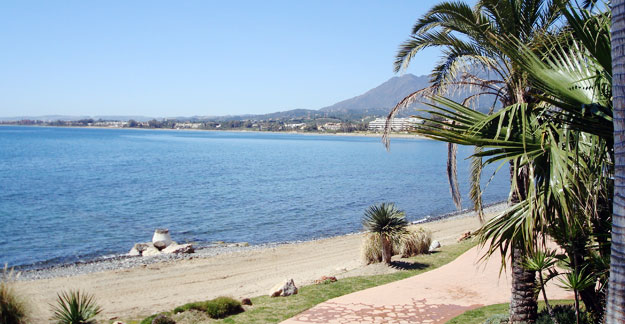
The shoreline is split into several well-kept stretches: Cortijo Blanco, El Ancón, Guadalmina, Linda Vista and San Pedro de Alcántara beach. There is also a dog-friendly section at Ventura del Mar. The sand is the darker tone typical of this part of the Costa del Sol, with a gentle slope, chiringuito beach bars serving sardine espetos, and a tree-lined promenade that is quieter than Marbella’s.
Guadalmina Beach, about 1.5 km long, sits in one of Marbella’s most established residential areas and has a landscaped promenade. A short walk away are the Roman baths and the watchtower. San Pedro Beach is the family stretch: wide, well serviced, regularly awarded a Blue Flag, and linked eastwards towards Puerto Banús along the Senda Litoral.
Real Club de Golf Guadalmina: 36 holes on the doorstep
Golfers have a home course here. The Real Club de Golf Guadalmina runs two 18-hole layouts — Guadalmina Norte and Guadalmina Sur — inside the estate of the same name. It is one of the oldest clubs on the western Costa del Sol, and on many plots the green really does sit in front of the house.
Within 10–20 minutes you can also reach Atalaya, Aloha, La Quinta and the golf valley of Nueva Andalucía (Los Naranjos, Las Brisas). If you are travelling with clubs, a private minibus from the airport is far simpler than juggling rank taxis and the AP-7 toll in high season.

San Pedro Boulevard: the park that joined the town to the sea
The Boulevard of San Pedro de Alcántara is the district’s defining piece of modern planning. It was built over the A-7 tunnel — some 54,000–55,000 m² of linear park — and removed the dual carriageway that once split the old town from the coast. A wavy footbridge, often called “A Wave Between Two Seas”, now links both sides and has become the town’s favourite photograph.
You will find gardens, fountains, a cycle lane, a skate area, outdoor gym stations, terraces and six children’s playgrounds. The open-air amphitheatre hosts concerts, theatre and fairground events. In the early evening it is where residents take their paseo: less glossy than Puerto Banús, and far more Andalusian.

Historic centre: Plaza de la Iglesia, Villa de San Luis and Avenida Marqués del Duero
The heart of the town is Plaza de la Iglesia, with the 19th-century parish church and shaded benches. From there, the palm-lined Avenida Marqués del Duero runs down towards the Boulevard: cafés, tapas bars and everyday shops rather than a stage-set old town. It does not try to rival Marbella’s casco antiguo; it is a place that works all year.
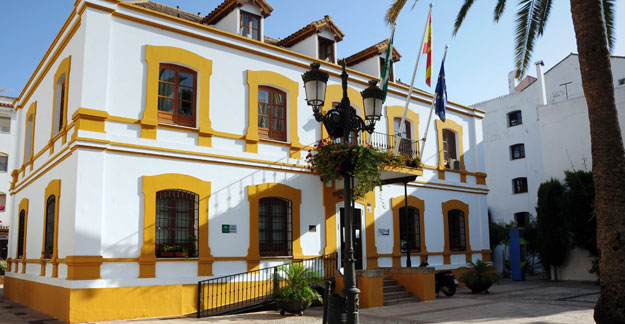
Villa de San Luis, a late-19th-century colonial mansion, now houses the district town hall and is one of the finest buildings in the centre. Nearby, the Trapiche de Guadaiza cultural centre and the CAE La Alcoholera gallery programme exhibitions and theatre.
History on the beach: Roman baths, basilica and watchtower
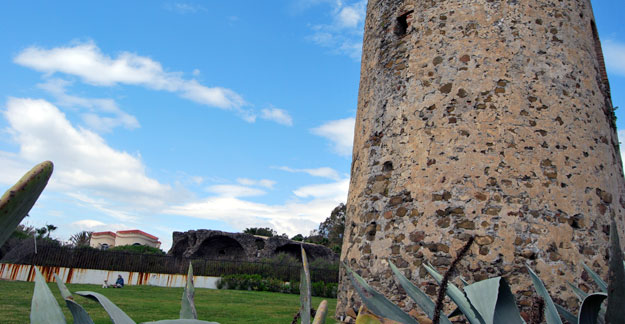
Tucked between estates and eucalyptus trees are three sites that span almost two millennia. The Roman baths of Las Bóvedas (2nd–3rd century) stand at the mouth of the Guadalmina, a few steps from the sand. The octagonal plan and hot, warm and cold rooms survive; they are linked to the settlement of Cilniana and the fish-salting works that once lined this coast.
About 500 metres inland, in Linda Vista, is the paleo-Christian basilica of Vega del Mar (4th–6th century), one of the most important early Christian sites in Andalusia: three naves, opposing apses, a baptistery and a necropolis. Some 50 metres from the baths rises the Torre de las Bóvedas, or Guadalmina watchtower, built around 1571–1575. It is 13 metres high and formed part of the coastal warning system against Berber raids.
Access from Guadalmina is straightforward, though opening hours are limited (often weekends and public holidays). Check with the San Pedro tourist office on Avenida Luis Braille / Marqués del Duero before you go.
The road to Ronda and the mountains
From San Pedro the A-397 climbs inland to Ronda (about 47 km) and the Serranía de Ronda, the old route between Seville and the Costa del Sol. It is one of Málaga’s most scenic drives, but it is steep, winding and busy with day-trip traffic in season. It pairs well with a white-village day if you do not want to spend every hour on the beach.
Food, the Thursday market and local life
San Pedro has a quiet reputation as the western Costa del Sol’s “secret dining room”: prices a notch below Banús and a proper Andalusian menu. On the promenade you eat espetos and fried fish; in the old streets, tapas, vermouth and brunch. The street market sets up on Thursdays in Calle Jorge Guillén, from 9:00 to 14:00.
Summer fills the Boulevard and Finca La Caridad with concerts. Carnival falls in February. The big week of the year is the Feria and Fiestas of San Pedro de Alcántara, around 19 October, the feast of the patron saint. In 2026 the fair is expected between 15 and 21 October (indicative dates; the Town Hall confirms them each September) at the La Caridad fairground: casetas, a parade of giants and big-heads, a procession and fireworks.
How to get to San Pedro de Alcántara from Malaga Airport
The run from Malaga-Costa del Sol Airport (AGP) is roughly 60–67 km and takes 45 to 55 minutes in normal traffic, depending on whether you use the A-7 or the AP-7 (the latter is tolled and usually quicker in July and August).
The public bus means a change at Marbella bus station and can stretch to almost two hours with luggage. A rank taxi adds up quickly if there are several of you or you are carrying golf bags. A private transfer from Malaga Airport meets you in the terminal, tracks your flight and drops you at the hotel, apartment or villa in Guadalmina, Linda Vista or Nueva Alcántara.
If the marina is your final stop, you can also book a transfer to Puerto Banus and finish along the promenade on foot or by bike. Westwards, the same car works for Estepona and the New Golden Mile.
Frequently asked questions about San Pedro de Alcántara
Is San Pedro de Alcántara a town or part of Marbella?
Administratively it is a district of Marbella, with its own deputy town hall. In practice it behaves like a town: it has a centre, a fair, a weekly market and a character quite distinct from Marbella centre or Puerto Banús.
How long does it take from Malaga Airport?
Between 45 and 55 minutes by private car. By bus, with the change in Marbella, allow close to two hours.
Which beach is best with children?
San Pedro Beach, next to the promenade and the Boulevard, is the most practical: facilities, a gentle slope and playgrounds a few minutes away. Guadalmina is quieter and more residential.
Can you visit the Roman ruins?
Yes. Las Bóvedas baths and the Vega del Mar basilica have controlled access and limited hours, usually at weekends and on public holidays. Confirm times at the tourist office before setting out.
When is the best time to visit?
April to June and mid-September to October: good weather, fewer crowds and, in October, the patron saint’s fair. July and August bring the fullest beaches, beach bars and concerts at La Caridad.
We hope you enjoy San Pedro de Alcántara at the same unhurried pace as the people who live there. If you need a car on arrival, or to move between Banús, Marbella and Estepona, Malaga Transfer offers transfers from Malaga Airport at a fixed price, with flight tracking and no extra charge for luggage.