Online Support


Torremolinos, on the Costa del Sol and just a few kilometres from Malaga airport, remains one of the most emblematic destinations on the southern Spanish coast. Born as a small fishing village, it became the cradle of modern tourism in Spain and a stronghold of freedom and openness. While the rest of the country was still under Franco’s dictatorship, this corner of the Malaga coastline attracted the first international jet-set: Ava Gardner, Frank Sinatra, Orson Welles, Marlon Brando and Brigitte Bardot, who even dared to sunbathe topless, turned its streets and beaches into an oasis of modernity and tolerance.
Today Torremolinos retains that liberal and open spirit. It is one of Europe’s most established LGBTQ+ destinations, with a vibrant scene throughout the year and a Pride festival that fills the town with colour every June. At the same time, it has left behind the low-cost tourism image of recent decades. Significant investment in hotels, seafront promenades and public spaces has returned it to the top tier of quality holiday destinations.
With a seven-kilometre coastal strip, an old town full of Andalusian charm and a complete leisure offer, Torremolinos has far more to offer than sun and beach alone. These are the five must-visit places to discover its best side.
1. The beaches of El Bajondillo and La Carihuela

The beaches are Torremolinos’s greatest attraction, and the two most popular and central ones are El Bajondillo and La Carihuela.
El Bajondillo, very close to the centre and Calle San Miguel, is a wide urban beach of golden sand with every facility. From here you can walk up the Cuesta del Tajo or take the lift that connects with the old town. Nearby stands the Casa de los Navajas and a good selection of beach bars and terraces.
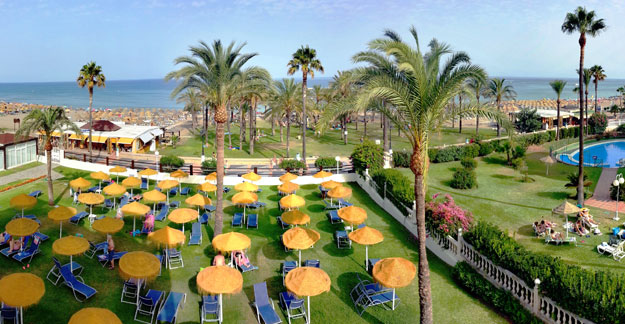
La Carihuela, to the west, still preserves the character of the old fishermen’s quarter. It is the ideal place to enjoy classic espetos de sardinas grilled over open fires and the traditional pescaito frito. Although the old free Pescaito Festival is no longer held as it once was, the gastronomic tradition remains very much alive in the many seafront restaurants. The promenade that links the two beaches, passing by El Morro, the rocky outcrop that separates them, is one of the most pleasant on the Costa del Sol for walking, cycling or simply watching the Mediterranean.
Both beaches hold the Q for Tourist Quality and are equally suited to families and those looking for a livelier atmosphere.
2. Calle San Miguel and the Torre Pimentel

The true historic heart of Torremolinos centres on Calle San Miguel, the town’s best-known pedestrian street. Lined with shops, bars, ice-cream parlours and terraces, it is the perfect place to stroll, pick up souvenirs or simply soak up the atmosphere.
At the end of the street, descending the Cuesta del Tajo towards the beach, stands the Torre Pimentel, formerly known as the Torre de los Molinos. This fourteenth-century Nasrid defensive tower, built around 1300, gave the town its name. It formed part of the coastal watchtower network of the Kingdom of Granada and from its height guards scanned the sea for possible invaders. Today it is listed as a Site of Cultural Interest. The interior cannot be visited, yet its silhouette remains one of the most photographed symbols of Torremolinos.
Nearby lies the El Calvario district, in the upper part of the town, which retains a more residential and authentic Andalusian village feel. Walking these streets is the best way to understand what Torremolinos was like before the tourism boom.
In the heart of the Bajondillo district, only a few metres from the beach, stands one of Torremolinos’s most beautiful and surprising buildings: the Casa de los Navajas. Built in 1925 for the Luque-Navajas family, linked to the sugar-cane business, it is a fine example of Neo-Mudéjar architecture with Mozarabic touches.
Its façade, with arches, tiles and ornamental detail, stands out among the modern buildings that surround it. In its day it formed part of the residences of wealthy families that began to transform the area alongside the first large hotels. Today it is used for celebrations, exhibitions, concerts and theatre, and can be visited free of charge (it is advisable to check opening times, as it is sometimes closed temporarily).
It is an essential stop for lovers of architecture and local history, and offers a very different image from the large apartment blocks that line the coast.
4. Parque de la Batería
If you are looking for a break from the bustle of the beach and the centre, the Parque de la Batería is the ideal place. Covering more than 74,000 square metres, it is Torremolinos’s great green lung. It lies to the north of La Carihuela, next to Montemar Alto train station, and offers privileged views of the sea.
The park features an artificial lake of more than 9,000 square metres where boats can be hired, a 15-metre lookout tower with panoramic lift, a large children’s play area, a cycle path, a running track, an exercise zone and the Parque Ibáñez, with sculptures of characters by the famous cartoonist. Remains of the old coastal defensive battery (cannons and bunkers) that give the park its name can still be seen.
It is a perfect space for families, for sport or simply for a stroll among more than a thousand trees of 25 different species. Open-air concerts and shows take place throughout the year, and entry is free.
5. Jardín Botánico Molino de Inca (and Aqualand)
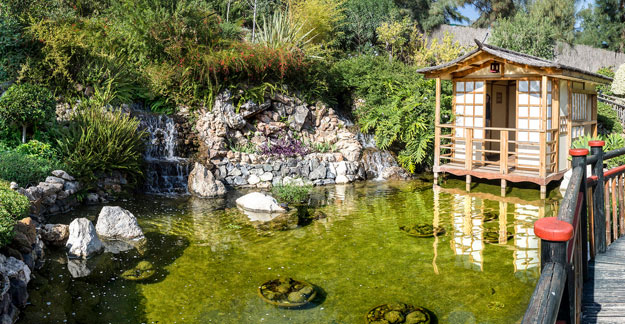
We close the list with a space of tranquillity and nature: the Jardín Botánico Molino de Inca, also known as Conjunto Los Manantiales. Located on the Camino de los Pinares, near the water park, this garden of more than 15,500 square metres is home to almost a thousand plant species, including 150 varieties of palm, 300 trees and around 400 shrubs.
Highlights include its Japanese-style Tsukiyama garden, the replica of the seventeenth-century hydraulic flour mill and the historic springs (the Inca spring and the Albercón del Rey, visited by King Alfonso XIII in 1926). It is a peaceful oasis where several bird species can also be observed.
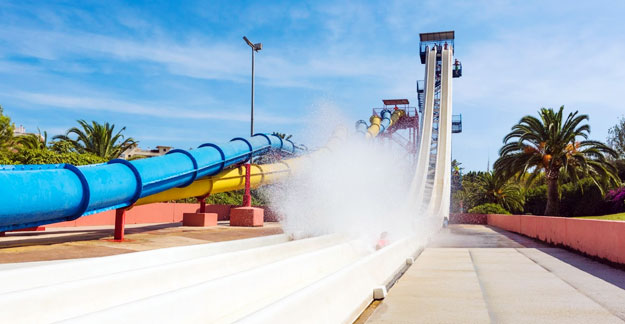
Very close by is Aqualand Torremolinos, the largest water park on the Costa del Sol, with adrenaline slides, children’s zones and wave pools. Next to it stands the Crocodile Park, one of the few crocodile parks in Europe, with more than 200 specimens and daily demonstrations. Both make an excellent choice if you are travelling with children or simply fancy a day of different entertainment.
How to reach Torremolinos without any hassle
Torremolinos lies only 10–15 minutes from Malaga airport, making it one of the most convenient destinations on the entire Costa del Sol. The best way to start your visit is with a private door-to-door transfer from Malaga airport to Torremolinos.
At Malaga Transfer we meet you in the terminal with your name on a board, monitor your flight and take you straight to your hotel or apartment with no waiting and no complications. We also provide transfers from María Zambrano train station or from any point in the province.
Torremolinos remains that special place where tourism began to write its modern history in Spain. With these five must-visit places you will have the perfect introduction to everything it has to offer. Book your transfer and start enjoying from the very first moment.