Online Support


About 50 kilometres north of Malaga lies Antequera, traditionally known as the geographical heart of Andalusia. This is where the main routes connecting the region’s four great cities – Cordoba, Granada, Seville and Malaga – all converge. With a population of around 42,000, Antequera surprises visitors with the richness and density of its heritage. Within a relatively compact town you will find more than fifty religious and civil buildings, an 11th-century Moorish Alcazaba and, above all, a megalithic complex more than six thousand years old that was declared a UNESCO World Heritage Site in 2016.
Together with Úbeda and Baeza, Antequera ranks among the Andalusian cities with the greatest and best-preserved historical and artistic heritage. Walking its cobbled streets, squares and slopes reveals an almost continuous sequence of churches, convents, palaces and defensive remains that tell the story of the town from prehistory to the present day.
1. The Antequera Dolmens Site
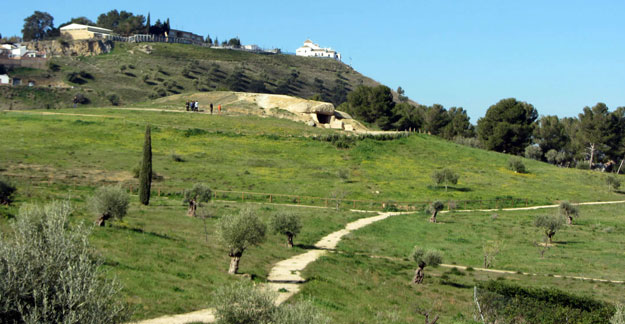
The dolmens of Menga and Viera together with the tholos of El Romeral form one of the most important megalithic constructions in Europe. Built around 6,500 years ago with enormous stone blocks weighing more than a hundred tonnes, they were used for ritual and funerary purposes. The Antequera Dolmens Site, inscribed on the UNESCO World Heritage List in 2016, brings together these three cultural monuments with two natural landmarks: the Peña de los Enamorados and El Torcal. It represents one of the earliest conscious integrations of architecture and landscape in European prehistory.
The dolmens stand at the entrance to the town, only 1.5 kilometres from the centre. A visit allows you to appreciate the monumental scale of the chambers and understand the deliberate orientation of the monuments towards the Peña de los Enamorados and El Torcal.
View the Dolmens location on Google Maps
2. The Alcazaba, historic centre and viewpoints
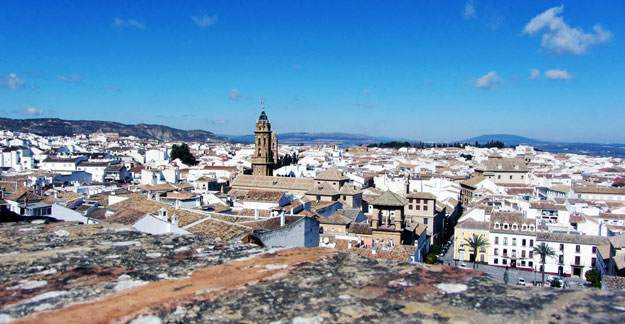
Antequera’s religious architecture is particularly rich. The outstanding building is the Real Colegiata de Santa María la Mayor, dating from the first half of the 16th century and declared a National Monument. Located in the upper part of the old town beside the Alcazaba, it is no longer used as a church but as a venue for exhibitions and concerts. In total the town preserves eleven convents, six churches and several chapels and hermitages.
Among the civil architecture the Alcazaba stands out – an 11th-century Muslim fortress. Its keep (Torre del Homenaje) is one of the widest of any Andalusí alcazaba. Next to it rises the Arco de los Gigantes, a 16th-century remodelling of an earlier Muslim arch. Other notable elements are the Puerta de Málaga of Nasrid origin and the gates of Estepa and Granada, both from the mid-17th century.
The whole forms a compact urban itinerary that can easily be explored on foot and that helps visitors understand the town’s evolution over the centuries.
The old town occupies the elevated part of the city, which explains the presence of several viewpoints with privileged views over the rooftops and the surrounding plain. The Mirador de las Almenillas, at the highest point beside the Alcazaba and the Arco de los Gigantes, offers a complete panorama of Antequera. A short distance away is the Mirador de la Plaza del Carmen. South of the Alcazaba, next to the Puerta de Málaga, lies the Mirador de la Niña de Antequera. From any of them the relationship between the town, its natural setting and the monuments that define it becomes clear.
View the Alcazaba location on Google Maps
3. El Torcal de Antequera

South of the town rises El Torcal de Antequera, one of the most spectacular karst landscapes in Europe. At almost a thousand metres above sea level, erosion has sculpted the soft limestone over millions of years into formations of extraordinary beauty and geological rarity. It forms part of the same UNESCO World Heritage Site as the dolmens and the Peña de los Enamorados.
The natural park offers several waymarked trails of varying difficulty, a visitor centre and parking areas. It is an ideal place for walking, observing flora and fauna, and contemplating a landscape that seems carved by a giant hand. A visit combines perfectly with the dolmens, as both elements belong to the same heritage ensemble.
View El Torcal location on Google Maps
Other nearby natural spaces
Some 30 kilometres to the north-east lies the Laguna de Fuente de Piedra, one of Andalusia’s most important wetlands and a major nesting site for flamingos. The Peña de los Enamorados, with its distinctive silhouette resembling a reclining human face, completes the visual landscape of the area. Its name comes from an old legend about two lovers of different religions who, cornered, leapt into the void.
For families or anyone interested in wildlife, Lobo Park, about 7 kilometres south of Antequera, allows visitors to observe different wolf subspecies in semi-freedom on guided tours.
Antequera’s gastronomy

After exploring the old town, its monuments and slopes, Antequera’s cuisine makes the perfect complement. The mollete de Antequera – a soft-crumbed bread with a thin crust – is the best-known product and is traditionally eaten at breakfast. Porra antequerana, a thicker relative of gazpacho, is ideal on hot days. Convent-made mantecados keep a centuries-old artisanal tradition alive, especially visible at Christmas. And bienmesabe, a dessert of angel hair, almonds, egg and cinnamon, closes the list of specialities that have travelled well beyond the local borders.
The bars and restaurants in the centre offer the chance to try these dishes in a relaxed, authentic atmosphere.
How to get to Antequera
Antequera lies about 50–60 minutes by road from Malaga Airport. Public transport options include medium-distance and regional trains from Malaga or Seville, as well as interurban bus services. These alternatives, however, often involve changes, limited timetables and extra journeys to reach the centre or the main sights such as the dolmens or El Torcal.
The most comfortable and flexible way to arrive is to book a private transfer from Malaga Airport to Antequera. The service is door-to-door: we meet you in the terminal with your name on a board, monitor your flight and take you straight to your hotel, the town centre or any point you choose. We can also collect you from anywhere else in the province if you decide to visit Antequera during your holiday on the Costa del Sol. You avoid waiting, connections and parking problems, and make the most of your time to enjoy the monuments and the landscape.
With its megalithic heritage, well-preserved historic centre, El Torcal and the natural spaces that surround it, Antequera stands out as one of the essential visits in inland Malaga province. A day or a weekend is enough to discover why this town remains the geographical and cultural heart of Andalusia.